Evaluating the Liquid Honey Seamless Pattern for Design Projects
In the realm of digital design and surface pattern creation, texture plays a pivotal role in establishing mood and brand identity. The Liquid Honey Seamless Pattern represents a specific category of organic textures designed to replicate the viscosity, gloss, and golden hues of natural honey. For designers, illustrators, and product creators, understanding the utility and limitations of such assets is essential before integrating them into a workflow. This evaluation explores the characteristics of these patterns, their practical applications, and the considerations necessary to determine if they align with specific project goals.
Understanding the Asset Characteristics
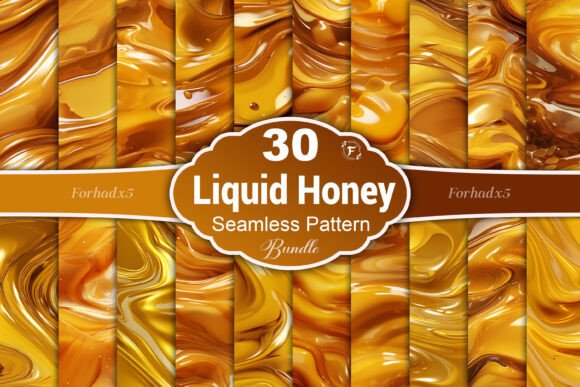
A Liquid Honey Seamless Pattern is fundamentally a high-resolution digital image engineered to tile infinitely without visible seams or interruptions. Unlike standard photographic backgrounds, these patterns are often crafted or enhanced to emphasize specific physical properties of honey: its translucency, its slow-moving fluidity, and its reflective surface. The typical bundle, such as those featuring golden wavy textures and organic drips, provides a library of variations ranging from thick, slow-dripping formations to smoother, flowing waves.
Technically, these assets are usually delivered in JPG format with RGB color profiles, optimized for screen display and modern printing processes. A standard resolution of 2400×2400 pixels offers sufficient density for most mid-scale print applications and high-definition web usage. The "seamless" feature is the critical technical component; it ensures that when the image is repeated across a canvas—whether for a website background or a roll of wrapping paper—the transition between tiles is imperceptible, creating a continuous field of texture.
Strategic Applications and Use Cases
The decision to utilize a honey-themed texture often stems from a need to evoke sensations of warmth, richness, and natural sweetness. These patterns are not merely decorative; they serve functional roles in branding and user experience where sensory association is key.
Print and Packaging Design
In the context of physical products, particularly within the food and beverage industry, these patterns are highly effective. For product packaging and food labels, a realistic honey texture can immediately communicate the nature of the contents to the consumer without relying solely on text. Beyond food, the aesthetic translates well to gift wrap and stationery. The organic, fluid nature of the design adds a tactile quality to greeting cards and scrapbooking pages, offering a premium feel that flat colors cannot achieve. When used in brochures or flyers for organic brands, the texture reinforces themes of purity and natural origin.
Digital and Web Environments
For digital interfaces, the application requires a more nuanced approach. While a high-gloss honey pattern can create a striking landing page background or a unique header for a blog, legibility is a primary concern. These textures are best employed as subtle overlays or in sections where text is minimal. They are particularly useful for social media ads and email marketing visuals where capturing attention quickly is vital. The golden tones can enhance the perceived value of a digital product or service, provided the contrast ratios remain accessible for all users.
Print-on-Demand and Merchandise
The rise of print-on-demand services has expanded the utility of seamless patterns. Apparel such as t-shirts and hoodies can utilize these designs for all-over prints, though the scale of the pattern must be adjusted to ensure the "drips" and "waves" do not appear distorted on fabric. Similarly, tote bags, phone cases, and home décor items benefit from the organic aesthetic. However, designers must consider the substrate; the glossy highlights inherent in the digital file may not translate identically onto matte fabrics or rigid plastics, requiring potential color correction or expectation management.
Benefits and Design Advantages
Integrating a pre-made Liquid Honey Seamless Pattern bundle offers several distinct advantages over creating textures from scratch. Firstly, it ensures consistency. A bundled set typically includes multiple variations that share a cohesive color palette and lighting style, allowing for a unified visual identity across different mediums. Secondly, it saves significant production time. Capturing high-quality macro photography of viscous fluids requires specialized lighting, equipment, and post-processing skills to eliminate unwanted reflections or debris. Utilizing a professional asset bypasses these technical hurdles.
Furthermore, the seamless nature of these files simplifies the workflow for surface pattern designers. Whether working in Adobe Photoshop, Illustrator, or Canva, the ability to drag and drop a tileable texture accelerates the prototyping phase. This efficiency allows creators to focus on layout and typography rather than texture generation.
Considerations and Potential Tradeoffs
Despite their versatility, liquid honey patterns are not a universal solution. There are specific scenarios where their use may be counterproductive or where alternatives should be considered.
Visual Overload: The high-contrast nature of glossy highlights against deep amber shadows can create visual noise. If a design relies heavily on intricate typography or complex data visualization, a busy honey texture may reduce readability. In such cases, a solid color palette inspired by honey tones, or a much lower opacity overlay, would be a more prudent choice.
Contextual Relevance: While the aesthetic is warm and inviting, it is inherently tied to specific associations: food, nature, luxury, and stickiness. Using this texture for a technology firm, a medical device, or a corporate financial report could send mixed messages or appear unprofessional. Designers must evaluate whether the sensory metaphor of "sweetness" aligns with the brand's core values.
Technical Limitations: Most bundles are provided in JPG format with an RGB color profile. For large-scale commercial printing (such as billboards or wide-format signage), the RGB color space may need conversion to CMYK, which can sometimes result in a shift in the golden hues, potentially dulling the vibrancy. Additionally, while 2400×2400 pixels is robust, it may require upscaling for very large format prints, which could introduce pixelation if not handled with care in raster-based software.
Making the Decision
Selecting the right texture asset involves balancing aesthetic desire with functional requirements. The Liquid Honey Seamless Pattern is a strong fit for projects aiming to convey organic quality, artisanal craftsmanship, or natural indulgence. It excels in environments where the texture itself is a focal point or a supportive element that enhances a narrow range of complementary colors.
However, if a project demands strict minimalism, high-contrast accessibility, or a cool-toned palette, this asset may not be the optimal choice. Designers should review the specific files in a bundle to ensure the scale of the "drips" and the intensity of the "gloss" match the intended output size. For web use, testing the pattern on various screen resolutions is advisable to ensure the seamless tiling performs smoothly without causing loading delays.
Ultimately, the value of a Liquid Honey Seamless Pattern Bundle lies in its ability to instantly inject a specific atmospheric quality into a design. By understanding both its evocative power and its technical constraints, creators can make informed decisions that elevate their work while maintaining clarity and purpose. Whether for a jam jar label or a digital campaign, the key is to let the texture support the message, not overpower it.